Estimate repayments with our Business Loan Calculator. Compare finance options, tailor loan terms, and plan with confidence for your business growth.
'Calculator results are estimates only and not quotes. Actual quotes will be provided by licensed brokers after you submit an enquiry.'
Business Loan Details:
Important!
Business Loan Interest Rates differ from lender to lender and will depend on your individual circumstances (credit history, employment status, age, etc.). To find out if you qualify ... and for a free, personalised interest rate and repayment quote,
please CLICK HERE
Business Loan Amortisation Calculator
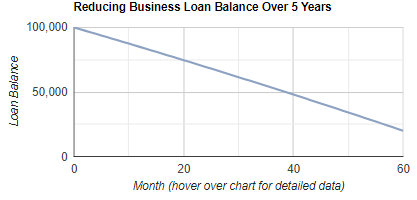
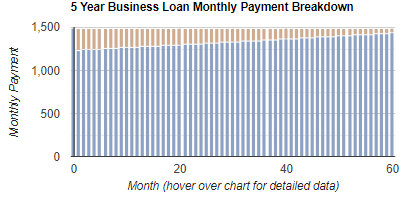
The following amortisation graphs detail month-by-month data on the progress of the proposed loan. The first chart below examines the reducing loan balance over the course of the finance contract term. The second graph illustrates the portion of each monthly repayment allocated to payment of interest vs principal reduction.
How to use our Business Loan Repayment Calculator
Our Business Loan Repayment Calculator helps you estimate business loan repayments, compare finance options and understand the true cost of borrowing before you commit. It is important because small changes to your loan amount, interest rate, term or balloon payment can materially change cash flow, total interest and end-of-term obligations. This calculator provides an indicative estimate only and is designed to support planning and budgeting for business growth.
How to complete each section for the best result:
1. Loan Amount
Enter the amount you expect to borrow as a whole number (no dots or commas). Include any costs you plan to capitalise into the loan, such as stamp duty, registration, insurance or other applicable fees, so the estimate reflects your real financed amount.
2. Balloon or Residual Payment (optional)
Select a residual as a percentage of the purchase price. A higher residual usually reduces ongoing repayments, but increases the amount due at the end and can increase total interest over the term. Choose a residual only if you have a realistic plan to refinance, pay it out, or sell an asset to meet the final amount.
3. Term of Loan
Select the number of years you want to repay the loan. A longer term generally lowers periodic repayments but increases total interest paid. A shorter term can reduce total cost but may place pressure on cash flow.
4. Interest Rate
Select an indicative annual interest rate to run a scenario. Your actual rate depends on lender assessment and your business circumstances, so consider testing multiple rates to stress-test affordability.
How to interpret the results:
1. Repayment estimate
Use the repayment figure as a budgeting guide for regular cash flow planning. If you selected a residual, remember the final payout is additional to the periodic repayments.
2. Amortisation charts
Review the reducing loan balance over time and the split between interest and principal. Early repayments typically include a higher interest component, with principal reduction accelerating later.
General information only, not personal financial advice. It does not consider your objectives, financial situation or needs. Consider the loan contract, fees, repayment frequency, and whether the repayments remain affordable under higher rates or lower revenue, and seek professional advice if required.
Fresh attention around Australian Taxation Office interest charges is giving small and medium-sized businesses another reason to treat tax debt as a front-line cash flow issue rather than a back-office problem. From the current income year, deductions are no longer available for general interest charge and shortfall interest charge amounts incurred on unpaid or underpaid tax liabilities. In practical terms, that can lift the after-tax cost of carrying ATO debt. - read more
Fresh small business tax reporting has put asset write-offs back in the spotlight, with many Australian SMEs again weighing whether to bring forward spending on vehicles, machinery, technology or fit-out. The practical message is clear: tax incentives can improve the after-tax cost of an eligible purchase, but they should not be treated as a substitute for a disciplined finance decision. - read more
Fresh industry reporting on business lending suggests Australian SMEs are still looking for ways to invest in productive assets, even while broader trading conditions remain uneven. Demand for finance linked to vehicles, machinery, technology and other equipment appears to be holding attention because these purchases can directly improve capacity, efficiency or service delivery. - read more
Fresh business risk reporting is sending another reminder that Australian SMEs are operating in a more selective lending environment. Measures such as payment defaults, external administrations and weaker trading conditions are being watched closely across the market, particularly in sectors exposed to discretionary spending, construction delays and cost inflation. - read more
Secured and unsecured business loans are two common types of finance available to Australian businesses. While both provide access to funding, they differ in how they are structured, the security requirements, borrowing limits and other loan features. - read more
The landscape of business funding is undergoing significant changes, offering new opportunities and challenges for small businesses. With evolving technologies, shifting market dynamics, and an increased focus on sustainability, entrepreneurs are seeing a transformation in how they secure and manage funding. - read more
Sustainable business funding helps Australian SMEs explore finance for projects that reduce environmental impact or support socially responsible operations. Understanding the available options, eligibility criteria and application process can help business owners plan green initiatives with greater clarity. - read more
Running a small or medium-sized business in Australia can be an exciting venture, full of potential and growth opportunities. However, maintaining a healthy cash flow is critical to keeping that dream afloat and thriving. This is where working capital loans come into play. - read more
Knowledgebase
Return on Investment (ROI): A measure used to evaluate the efficiency of an investment or compare the efficiency of several different investments.